Appendix
Notes on Method.
how this journal was pressed, bound & sent to the Internet
A. The Concept
Herbarium treats the agency as an obsessively curious naturalist studying the digital world. Services become classified specimens; projects become findings from the field; the contact page becomes correspondence, sealed in wax. The wit lives in the captions — the facts stay exactly as the agency wrote them.
Everything sits in one continuous paper world: grain, deckled edges, washi tape, brass pins, ruled specimen labels, and marginalia in a hand that can't stop annotating. Kinfolk-meets-Darwin, warm and a little eccentric.
n.b. — the Latin classifications (Servitium: Automatio & co.) are playful taxonomy, not actual Latin scholarship.
B. Design System
Pigments
- Cream Paper
#F7F2E7the journal itself - Moss Green
#31473Aheadings; the forest - Terracotta
#C4622Dwax, ribbon, annotations - Faded Sepia Ink
#4A3F32every written word
Type Specimens
Obsessively Curious.
Fraunces Variable — optical size pushed to 144, the WONK axis switched on (note the leaning
“u” forms), SOFT axis used for gentler labels. Loaded via
@fontsource-variable/fraunces, self-hosted, no CDN.
see also: automation, p.4 — annotations live in Newsreader italic,
Newsreader Variable, an editorial text face with a beautiful italic. Body copy runs at optical size 16; marginalia drop to 11 for that scribbled-in-the-margin colour.
C. Tech & Motion
- Astro 5, fully static. One small inline script drives every animation — an IntersectionObserver adding classes. No frameworks, no runtime dependencies.
- The draw-in system. Every hand-drawn stroke is an SVG path carrying
pathLength="1", sostroke-dasharray: 1normalises any path. In view, the dash offset transitions from 1 to 0 and the line draws itself. Live demonstration: - Paper physics. Sections settle in from a −1° rotation with a paper-soft
cubic-bezier, the way a turned page comes to rest. Deckled edges are real geometry: an SVG
feTurbulence+feDisplacementMapfilter roughens each sheet's edge (two seeds, so no two sheets tear alike). Grain is a tiny inline-SVG noise tile multiplied over the page. - Reduced motion, honoured. Under
prefers-reduced-motionevery stroke renders already drawn, pages arrive already settled, and hover lifts become shadow changes only. - Lean payload. Two variable fonts, seven WebP engravings (40–233 KB), zero JavaScript beyond the observer script. The bookmark ribbon is one CSS variable driven by scroll.
D. AI Assets
Both engravings were generated with GPT Image 2 via the Higgsfield CLI. Prompts and
aspect ratios live in shared/assets/manifest.json; the batch run is logged to
gen.log. The botanical sheet was then cropped into six individual specimens with
sharp and everything re-encoded to WebP at display size.
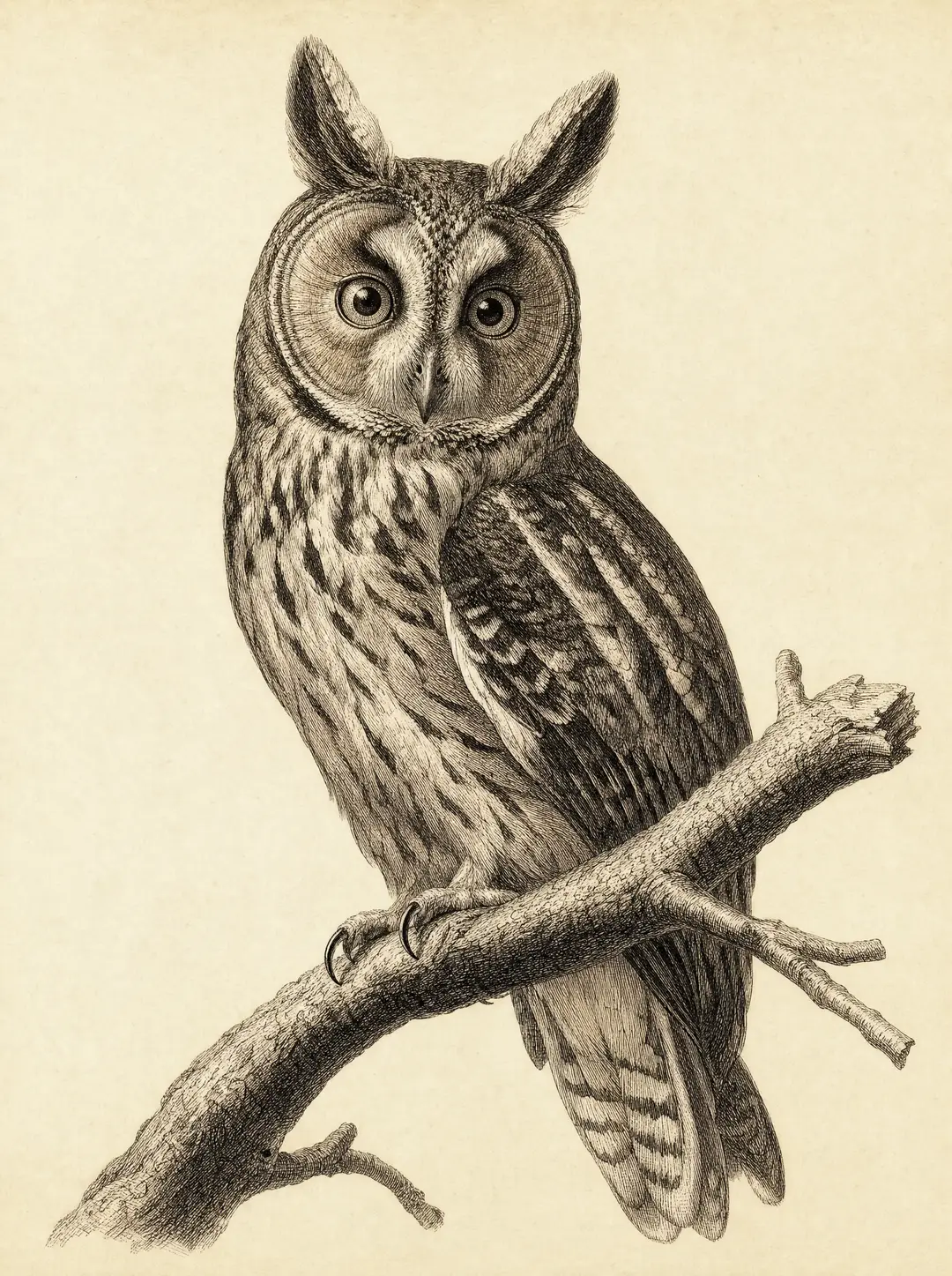
Antique 18th century copperplate engraving of a long-eared owl perched on a branch, fine crosshatched linework, sepia-black ink on aged cream paper, scientific natural history illustration style of Buffon, detailed feathers, plain cream background, no text, no letters, no border, no watermark
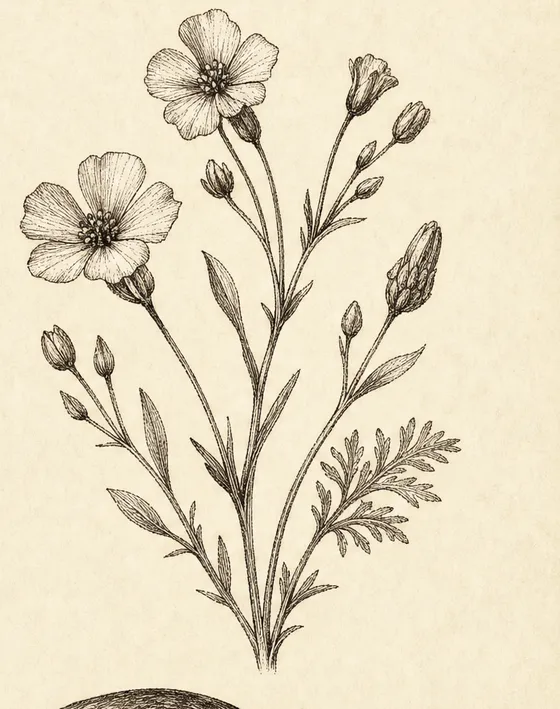
Sheet of separate antique botanical copperplate engravings arranged with space between them: a fern frond, a seed pod cross-section, a sprig of wildflowers, an oak leaf with acorns, a mushroom — fine crosshatched sepia-black ink linework on aged cream paper, scientific herbarium plate style, each specimen isolated on plain cream background, no text, no letters, no watermark
shown: the wildflower sprig, one of six crops taken from the single generated sheet (fern, seed pod, wildflowers, oak leaf, mushroom, acorn detail).
E. How to Reproduce
- Scaffold Astro 5 (static output) and add
@fontsource-variable/fraunces+@fontsource-variable/newsreader. Importfraunces/full.cssto get the SOFT and WONK axes. - Generate the two plates with the prompts above; crop specimens out of the sheet with
sharp(extract→resize→webp). - Build the paper world first — grain tile, deckle filter, tape, pins, ruled labels — before any layout. Every surface must read as paper on paper.
- Give every hand-drawn SVG path
pathLength="1"and wire one IntersectionObserver for draw-ins and page settles. - Set the display type in Fraunces with big optical-size contrast; keep every annotation in Newsreader italic. Let the wit live in captions only.
npm run build, audit with Playwright at 1440×900 and 390×844, and iterate until the paper feels real.
F. Credit
Designed & built by Claude (Anthropic) for Nomadic Owls. One of ten directions — see the other nine at nomadic-ten.pages.dev.